How long have you been a member of the Hill-Top Creative Arts Foundation, and how did you discover HCAF?
I have been a member of the Hilltop Creative Arts Foundation since at least August 2024. I was introduced to the Foundation by Daniel Aôndona and Precious Chidera Harrison if I recall correctly.
What would you do differently if you were to start your creative journey afresh today?
I actually do not think I would do anything differently if I were to start my creative journey afresh today. The thing about the creative process, especially as a beginner, is that we always have to start from somewhere. Somewhere more rudimentary. Somewhere earthly. Somewhere basic— and then we have to find our way up. This was essentially how I began. Obviously I'm not the same writer I was 2 years ago and all of those early poems, all of the reading and studying and writing have constituted and contributed in building me into the poet I am today.
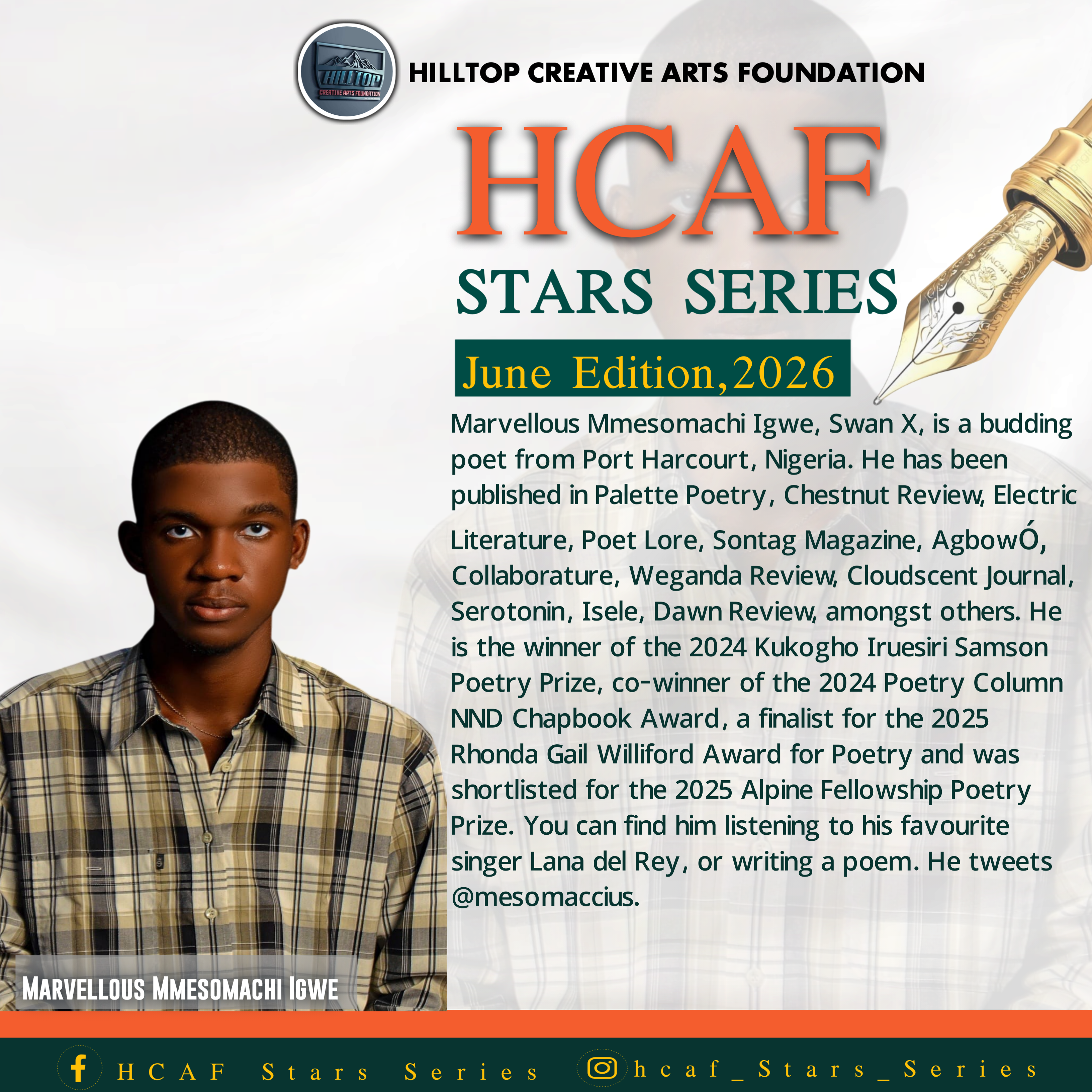
Of what significance is it to you and your creative journey that you are being recognised and celebrated as one of our stars?
It is an honor to be included in the HCAF Stars Series. I am incredibly grateful to the Foundation for giving me this opportunity. It means a great deal to me.
To those looking up to you, hoping to be like you, what would you say it takes, holistically, to be a star writer?
I'd say the hard work. You have to put in the work required to excel in your craft. You have to read. You have to study. You have to write, and write, and write. The poems may not come out stellar at first, and yes, that is the natural process. We all had to crawl before we could run, so focus and commit intently to improving your craft, and don't give up.
How does being a writer shape the way you see or approach your other personal roles?
Being a writer has given me a greater sensitivity to my approach with other personal roles. I'm an engineering student, and because of my love for literature, I find myself trying greatly, with my poems, to bridge the chasm between hard science and literary art. I have noticed this with other poets coming from this background too. My poems incorporate these two almost equally. It has given me a greater insight to the way things are, to the way they could possibly be.
Are there any writers or artists who have influenced your work or creative voice?
Yes. Ocean Vuong, Richard Siken, Samuel Adeyemi, Chiwenite Onyekwelu, Michael Imossan, Noor Unnahar, Louise Glück, and Ameen Animashaun.
If you could create a work that tackles a major issue in the world, what genre would you choose, and what issue would you aim to solve?
Definitely poetry. And I already have works touching on global and regional issues. My poem, Ceuta, published on Mascara Literary Review, dwells on the perils of conflict-induced migration and its psychological effects on the displaced. Several of my poems dwell on this issue too, including Japa, which was a honorable mention for the Rhonda Gail Williford Award for Poetry in 2025 and is published in IHRAM. Another theme I've noticed I write a lot in is that of sickness, disease and death. They recur a lot in my poems.
Do you create primarily as an act of self-expression or as a dialogue with an audience?
I create primarily as an act of self-expression. My poems are almost solely a way of familiarizing with myself, a form of inquiry into myself. Everytime I write a poem I am trying to answer an invisible question. Everytime I write a poem I am Adam in the fresco in the Sistine Chapel reaching towards the glinting finger of God.
 Interview — Abdulwasi’H Olaitan